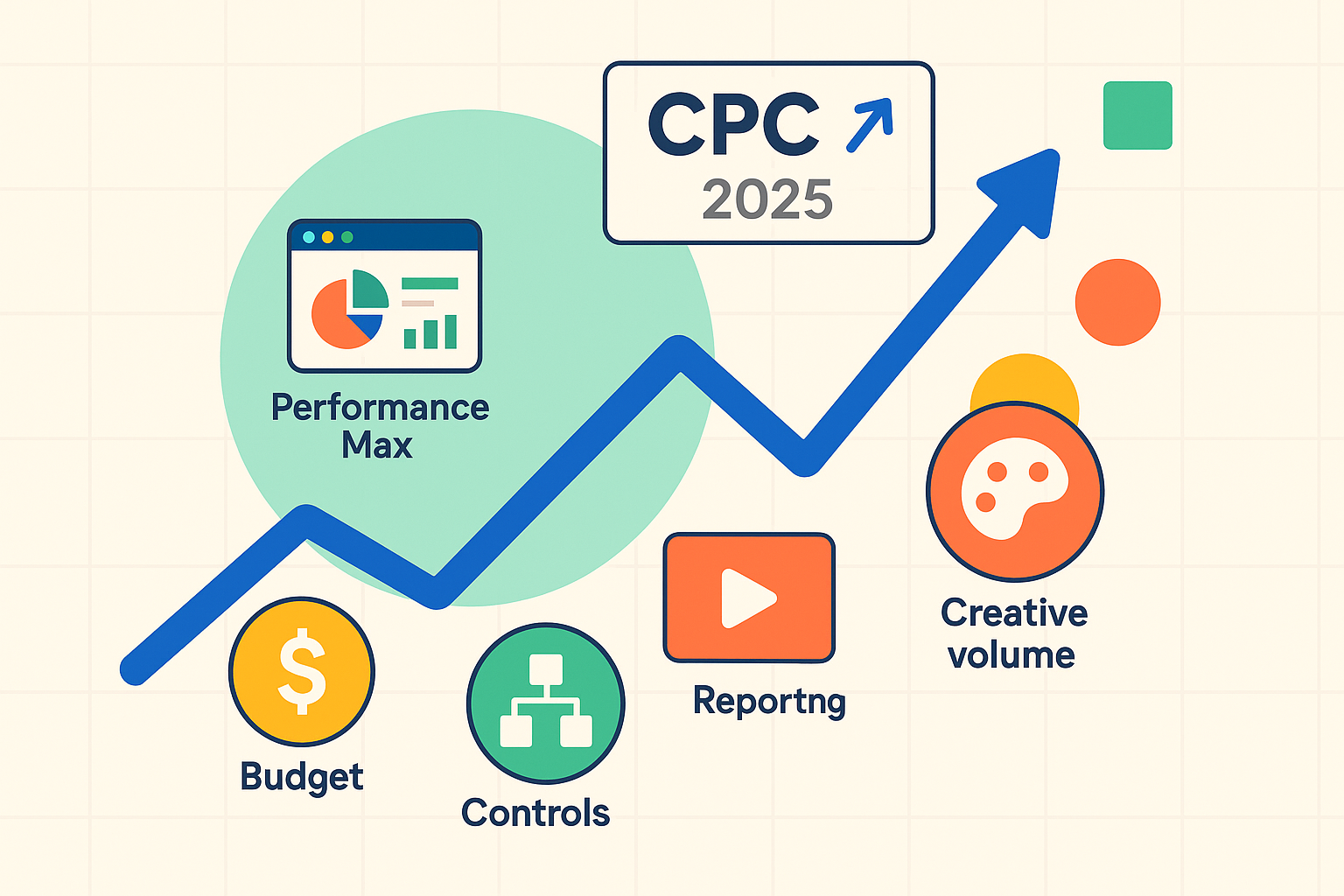
Clicks are getting dearer, so efficiency must come from account structure, creative volume, and cleaner measurement—not bigger bids. Multiple industry datasets show CPCs trending up into 2025, with spend growth often outpacing traffic growth; meanwhile, Google’s newer reporting (especially for Performance Max) makes it easier to see which channels and assets actually pull their weight. WordStreamSearch Engine Land
The context (and why it matters)
Across recent benchmarks, Google Ads costs are rising. WordStream’s 2025 dataset shows the average CPC up ~12.9% YoY, while Search Engine Land’s coverage of Tinuiti’s Q1–Q2 2025 data highlights ad spend rising faster than click growth, i.e., more of your budget is being eaten by price rather than volume. Translation: you pay more for the same attention, so structure, creative and signal quality carry the ROI. WordStreamSearch Engine Landkarooya.com
On the positive side, Google added channel-level reporting for Performance Max and related insights in 2025—making it easier to allocate spend to what actually works. TheeDigital
What we’re changing (and how you can copy it)
1) Budgets: ring-fence, rebalance, defend
Separate brand vs non-brand with distinct budgets/targets so brand doesn’t mask prospecting inefficiency.
Re-allocate 10–25% toward more cost-resilient surfaces: Shopping/PMax for retail; Demand Gen/YouTube for everyone; Local Services Ads where eligible. (Check LSA eligibility before you plan.) Debuggers Studio
Forecast on CAC/LTV, not last-click ROAS—price pressure is outpacing traffic in several quarters. Search Engine Land
2) Bidding: value or bust
Import offline outcomes (SQLs, revenue/margin) and assign values by lead type or product line; then run tROAS/tCPA with conversion value rules to weight high-value users/geographies.
Use portfolio bid strategies and seasonality adjustments for promos (short events, 1–7 days). OWOXGoogle Help+1
3) Negatives & controls: cut waste weekly
Maintain account-level negative lists (competitors for non-brand, job-seekers, DIY).
Search Partners: keep off unless proven profitable; test methodically per account.
Brand exclusions in PMax to preserve non-brand intent. Google Help+1
4) Query-matching reality check (and how to sculpt it)
Keep a tight, profitable Exact set for money terms; layer Phrase for controlled discovery with a rigorous SQR cadence.
Use single-theme ad groups (STAGs) around intents (price / “near me” / compare / problem).
In retail, combine Shopping priority tiering with PMax + brand exclusions to police traffic mix, then shift budget using 2025 PMax channel/search-term insights. TheeDigital
5) Creative volume (your cheapest lever)
RSAs: up to 15 headlines / 4 descriptions. Our working ratio: 8–12 unique headlines + 3–4 descriptions; keep pinning minimal unless legally required. Google Help
Assets: sitelinks, price/promo extensions, structured snippets, callouts—use them to grab more screen real estate.
Demand Gen / YouTube: ship sets, not single videos. Create 6–15s hooks and 30–45s explainers, with a 9:16 ≤60s cut for Shorts. (Shorts placements cap at 60 seconds.) Google Help
6) Measurement you can trust
Turn on Enhanced Conversions (web or API) to boost match rates with hashed first-party data; accept modelled conversions but improve signal quality with better tagging. bidnamic.com
Close the loop weekly: pass lead scores/revenue back so Smart Bidding learns from quality, not just quantity.
Use PMax channel reporting to move spend from low-yield surfaces to proven ones. TheeDigital
7) Retail add-ons (if you sell products)
Enrich your Merchant Center feed (titles with brand + model + key attribute + intent, GTIN/MPN) and keep delivery/returns up-to-date.
Obey image rules (no text/watermarks; size minimums); Google publishes specs and will flag overlays. Google Help+1
8) Lead-gen add-ons (if you sell services/B2B)
Pre-qualify on-page (budget/timeline) to protect sales time.
Add micro-conversions (guide downloads, demo views) to feed Smart Bidding during longer sales cycles.
For eligible verticals, layer Local Services Ads (pay-per-lead; strict eligibility). Debuggers Studio
Your H2 routine (copy–paste into your runbook)
Weekly
Not sure where to start?
We help businesses build marketing systems that actually work. Let us show you how.
Get Your Free Growth Plan →SQR & negatives → pause/negate the top 10 wasters
Budget re-allocation by marginal CPA/ROAS → move 10–15% to winners
RSA refresh → test 2 new headlines + 1 new offer line
PMax / Demand Gen checks → shift spend by channel & device (use 2025 channel insights) TheeDigital
Monthly
Import CRM outcomes; refresh value rules
Re-forecast by CAC/LTV, not last-click
Creative sprint (new video cut + fresh imagery)
Landing-page speed & conversion audit
Quarterly
Incrementality test (geo split/holdout)
Offer revamp (price tests, bundles, finance)
Structure review (consolidate weak ad groups; re-theme by intent)
What we’re not doing (and neither should you)
Chasing volume with Broad + Maximise Clicks—costs inflate, learning stalls
Letting brand prop up blended ROAS—masks a non-brand hole you must fix
“Set & forget” RSAs—2025 rewards iteration, not static assets
Relying solely on last-click—use value-based targets with offline imports
QA checklist (15 minutes before launch)
Coverage & strength: hit Excellent/Good Ad Strength in PMax/Demand Gen; fill text, image, logo, video slots (per Google’s 2025 specs). Google Help
Policy & previews: run Ad Preview & Diagnosis; fix blockers in Campaign diagnostics.
File specs sanity: RSA limits (15/4), YouTube Shorts ≤60s, image ratios OK. Google Help+2Google Help+2
Why this works now
CPCs are up in many sectors (e.g., WordStream’s overall +12.9% YoY), and several Q1-Q2 2025 reads show spend growth led by rising CPCs more than clicks—especially on branded queries. Building profit durability means teaching the system what a good click looks like and earning cheaper auctions with better creative and signals. WordStreamSearch Engine LandAmazon Web Services, Inc.
Visibility is better: new PMax channel insights make it simpler to move budget to effective surfaces, rather than guessing. TheeDigital
