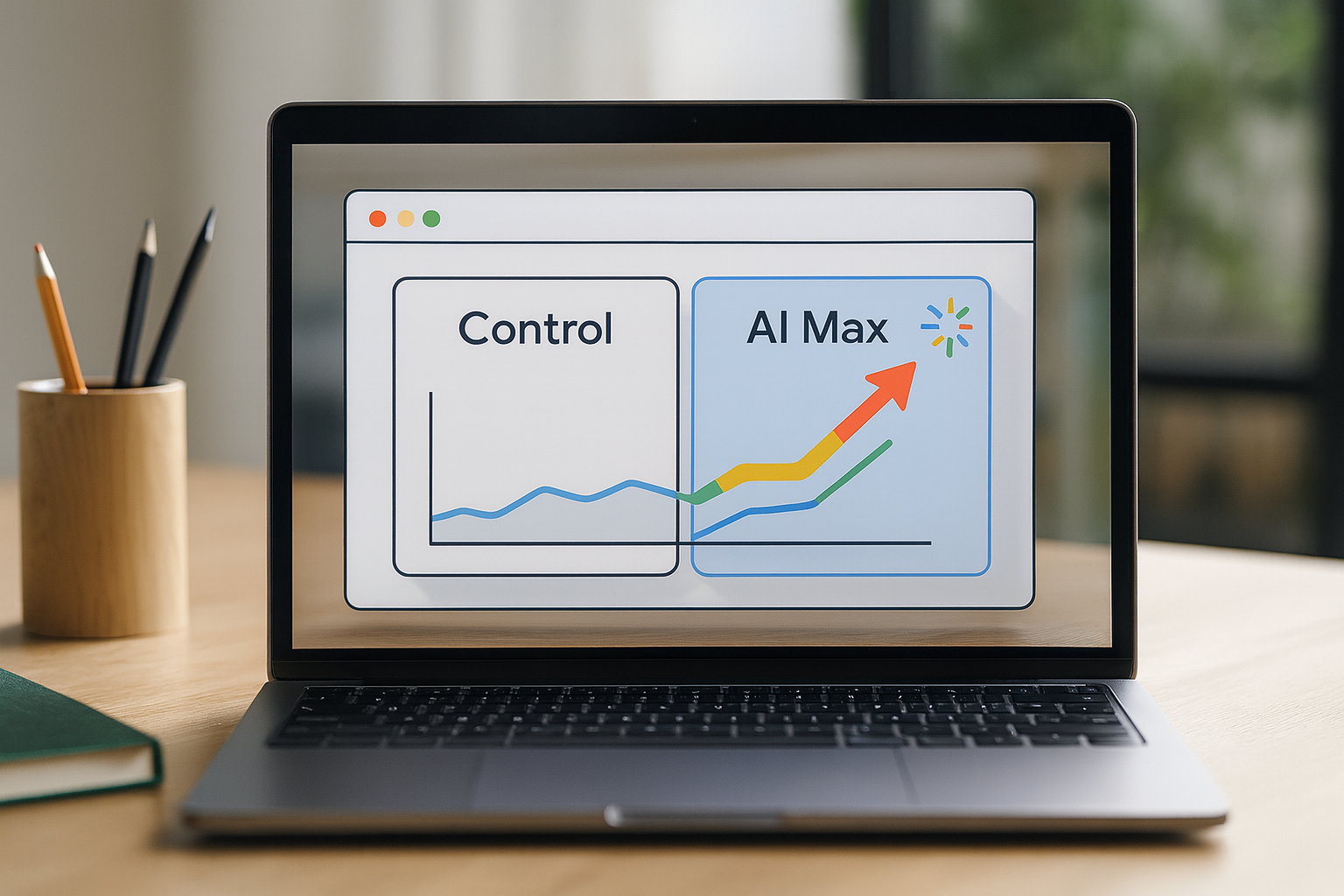
Google’s AI Max for Search isn’t another toggle you forget about after launch. It’s a new layer that rewires how your Search campaigns find queries, write copy, and choose landing pages—while giving you fresher reporting to see what actually happened.
As of September 2025, AI Max is available to all advertisers globally (still in beta) across the Google Ads UI, Editor, SA360, and the API. That’s the widest runway yet for hands-on testing and adoption. blog.google
What AI Max actually does
Under the hood, AI Max is two big engines working together:
-
Search term matching expands beyond your current keywords using broad match and keywordless tech. It learns from your existing keywords, creatives, and URLs to surface additional relevant queries—then labels them in reports so you can see where lift came from. You’ll also get brand controls and “locations of interest” to shape where this extra reach goes. Google Help
-
Asset optimization upgrades creative and routing. Text Customization (the successor to Automatically Created Assets) generates headlines and descriptions from your domain, landing pages, and ad context; Final URL expansion can send users to a more relevant page on your site when it’s predicted to perform better. Both are controllable in campaign settings, with asset-level reporting to keep you honest. Google Help+1
A few nuances matter:
-
Text Customization replaced ACA in May 2025, and now lives inside AI Max. If you want Google-generated text assets, this is where you enable and review them. Google Help
-
Final URL expansion requires Text Customization to keep copy aligned with the landing page. If expansion chooses a different URL, your pinned RSA assets may be ignored to avoid mismatches. In short: great for relevance, risky if your site structure is inconsistent. Google Help
What the numbers say (treat them as a bar, not a promise)
Google’s internal 2025 data points to ~14% more conversions or conversion value at similar CPA/ROAS when AI Max is activated in Search. Your mileage depends on landing page quality, brand rules, and how tightly you manage negatives, but it’s a clear signal that the lift isn’t just theoretical. Google Help
Why this changes the creative conversation
Text Customization isn’t just filler copy. It’s built to pull benefits, proof points, and CTAs from your own site and combine them with your RSA assets. Done well, it gives you variation at scale without losing voice; done lazily, it mirrors weak pages and amplifies them. The fix isn’t “turn it off”—it’s write clearer pages above the fold, keep non-negotiable phrases pinned, and prune any generated lines that drift off-brand in the asset report. Google Help
Not sure where to start?
We help businesses build marketing systems that actually work. Let us show you how.
Get Your Free Growth Plan →The reporting is finally useful
AI Max adds clarity you can act on:
-
A new match-type value for AI Max in the Search Terms report, plus a source column that distinguishes broad-match expansion from keywordless matches.
-
A combined view that pairs search term + served headlines + URLs to show the full journey.
-
Landing Pages and Asset reports that separate out AI Max’s contributions.This is the kind of transparency buyers have been asking for since “black-box” automation entered the chat. Google Help
Where AI Max meets AI Overviews
Search, Shopping—and in some cases Performance Max—ads can now appear inside or around AI Overviews in the U.S. (English) on mobile and desktop, with expansion to select English-speaking markets later in 2025. That means your RSA framing (benefit line, proof, CTA, sitelinks) may be read next to an AI summary rather than ten blue links. It’s still the same campaigns; eligibility flows from your existing setups. Google Help+1
Common worries, clarified
-
“Will it wreck my brand voice?” Not if you use pins for legal/brand language and remove off-brand assets in reports. The system exposes every generated line so you can audit. Google Help
-
“Is keywordless matching a free-for-all?” No. Brand settings, locations of interest, URL inclusions/exclusions, and campaign-level negatives still apply—and they matter more than ever. Google Help
-
“Can I see what changed?” Yes. The reports call out AI Max’s matches, assets, and selected landing pages so you can connect spend to outcomes. Google Help
Bottom line
AI Max pushes Search closer to intent-first advertising: less hand-sorting of queries, more emphasis on clear offers, strong pages, and decisive guardrails. If your site tells a sharp story and you’re willing to curate what the machine suggests, AI Max is a net gain. If your pages are thin and your negatives are a mess, it will mirror that back at you—fast.
And that’s the point: AI Max doesn’t replace fundamentals. It punishes sloppy ones and rewards teams who keep them tight.