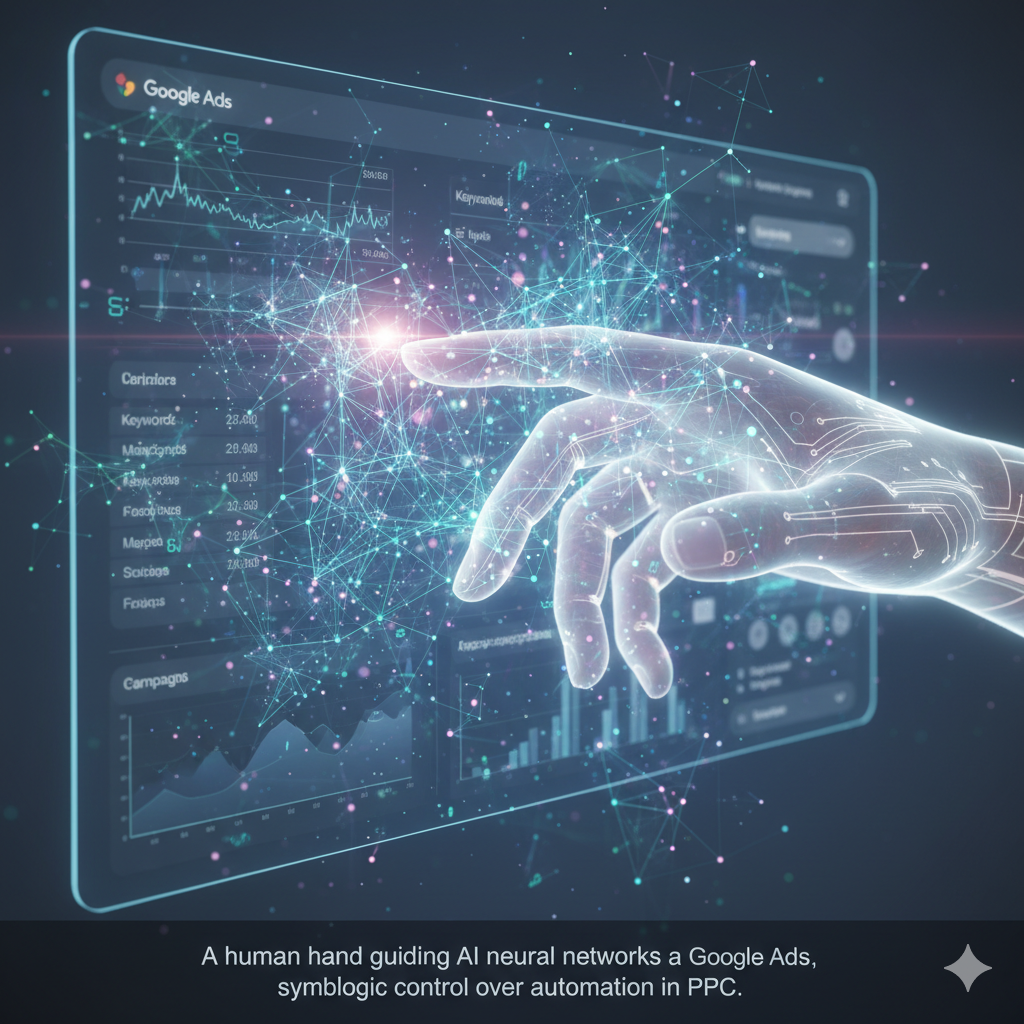
The era of traditional Google Ads is over. In its place, a new, more powerful, and undeniably complex landscape has emerged—one dominated by Artificial Intelligence.
From Smart Bidding to Performance Max, and now with AI Overviews (AIOs) reshaping search results, AI is no longer a peripheral feature; it’s the very engine driving Google Ads performance. For businesses and marketers in 2025, understanding and strategically leveraging AI isn’t just an advantage—it’s a prerequisite for survival and growth.
This comprehensive guide will demystify AI in Google Ads. We’ll explore:
- How Google’s AI works across different campaign types.
- The fundamental shifts required in your strategy.
- How to “talk” to the AI through data, creative, and precise inputs.
- Actionable steps to ensure you’re guiding the machine, not being replaced by it.
Welcome to the future of PPC. Let’s master it together.
1. The AI Revolution in Google Ads: A Paradigm Shift
For years, PPC management was about manual control: keyword bidding, exact match optimization, and granular campaign structures. While these elements still have a place, the underlying mechanics have changed dramatically.
Google’s AI is designed to:
- Process Vast Data: Analyze billions of data points in real-time (user intent, device, location, time, past interactions, competitor bids, weather, etc.) far beyond human capability.
- Predict & Optimize: Forecast conversion likelihood and adjust bids, ad creatives, and placements automatically to achieve predefined goals.
- Cross-Channel Efficiency: Break down channel silos, finding the optimal path to conversion across Search, Display, YouTube, Discover, and Gmail.
This shift means the role of the human advertiser is evolving from a button-pusher to a strategic director, data architect, and creative visionary.
2. Pillars of AI: Where Google Ads Automation Lives
Google’s AI manifests across several core areas of the platform. Understanding each is crucial for effective management.
2.1 Smart Bidding: The Automated Auctioneer
Smart Bidding strategies (e.g., Target CPA, Target ROAS, Maximize Conversions/Conversion Value) use AI to optimize bids in every single auction.
- How it Works: Rather than setting static bids, Smart Bidding analyzes contextual signals (device, location, time of day, audience, past search behavior) to predict conversion likelihood in real-time and bid accordingly.
- Your Role: Set clear conversion goals, feed it accurate conversion data (including values), and monitor performance. Your job is to define what success looks like, not how to bid for it.
2.2 Performance Max (PMax): The Cross-Channel Growth Engine
PMax is Google’s most advanced, fully automated campaign type, designed to find converting customers across all Google inventory.
- How it Works: You provide asset groups (headlines, descriptions, images, videos) and audience signals (first-party data, custom segments). Google’s AI then combines these assets dynamically and shows them to the most relevant users across Search, Display, YouTube, Discover, and Gmail to achieve your conversion goals.
- Your Role: Provide high-quality assets, strong audience signals, and robust conversion tracking. PMax is a “black box,” so your control comes from the quality of your inputs and strategic exclusions.
2.3 AI Overviews (AIO): Reshaping the SERP
Integrated into standard search results, AI Overviews provide generative AI summaries directly at the top of the SERP, potentially impacting ad visibility and user click behavior.
- How it Works: For many queries, Google’s AI synthesizes information from various web sources to provide a direct answer, often with follow-up questions, product carousels, or related links.
- Your Role: Adapt your ad strategy (Search & Shopping) to maintain visibility above, within, or below AIOs. This involves optimizing ad copy for transactional intent, enriching product feeds, and monitoring new SERP layouts.
2.4 Responsive Search Ads (RSAs) & Dynamic Search Ads (DSAs): Creative Automation
RSAs and DSAs leverage AI to serve the most effective ad copy combinations.
- RSAs: You provide up to 15 headlines and 4 descriptions. Google’s AI then tests different combinations to find the highest-performing ones for each search query.
- DSAs: Google’s AI scans your website content and automatically generates headlines for your ads, dynamically matching them to relevant search queries.
- Your Role: Provide diverse, compelling headlines and descriptions for RSAs. Ensure your website content is high-quality and well-structured for DSAs.
3. The New Rules of Engagement: How to “Talk” to the AI
Successful AI-powered PPC isn’t about letting go; it’s about strategic guidance. Here’s how you influence Google’s AI for optimal results:
Not sure where to start?
We help businesses build marketing systems that actually work. Let us show you how.
Get Your Free Growth Plan →3.1 Data is Your Language: Precision in Tracking
The AI is only as smart as the data you feed it. Flawed data leads to flawed decisions.
- Accurate Conversion Tracking: This is paramount. Ensure all relevant conversions are tracked accurately in Google Ads and Google Analytics 4 (GA4).
- Conversion Values: For e-commerce and lead gen, assign accurate values to your conversions. This allows the AI to optimize for profit (ROAS) rather than just volume (CPA).
- Enhanced Conversions: Implement Enhanced Conversions to send hashed first-party data, improving conversion measurement accuracy and giving the AI more signals.
- First-Party Data Signals: Leverage Customer Match lists, custom segments, and other first-party data as “Audience Signals” in PMax to guide the AI towards your most valuable customer segments.
3.2 Creative is Your Input: Fueling the Machine
Creative assets are the new keywords, especially for visual-heavy AI campaigns like PMax and Demand Gen.
- Diverse & High-Quality Assets: Provide a wide variety of headlines, descriptions, images, and videos for PMax and RSAs. The AI needs options to test and combine.
- Performance-Driven Creative: Don’t just “fill in the blanks.” Regularly analyze asset performance and replace underperforming assets. Use AI-powered creative tools to generate and test new variations rapidly.
- Video First: For many PMax campaigns, video assets are critical as YouTube is a major distribution channel. Invest in compelling, short-form video.
3.3 Strategic Boundaries & Exclusions: Guardrails for Automation
While automation is powerful, you still need to set guardrails to protect your brand and budget.
- Negative Keywords: Essential for both Search and PMax. Use broad negative keyword lists to prevent irrelevant traffic, especially for brand safety.
- Brand Exclusions: Strategically exclude your brand terms from PMax if you manage dedicated, high-performing brand Search campaigns to prevent cannibalization.
- Placement Exclusions: For PMax, monitor placement performance (if available) and exclude low-quality sites/apps on the Display or YouTube networks.
- URL Exclusions: Prevent PMax from promoting low-value pages on your website.
3.4 Goal-Oriented Bidding: Setting the Destination
Your choice of Smart Bidding strategy tells the AI what you want to achieve.
- Align with Business Goals:
- Target ROAS: Ideal for e-commerce, focusing on maximizing revenue relative to ad spend.
- Target CPA: Best for lead generation, aiming for a specific cost per lead.
- Maximize Conversion Value: Good for lead gen or e-commerce with varying conversion values, focusing on total value.
- Provide Sufficient Data: Smart Bidding needs a consistent flow of conversions to learn and optimize effectively. Campaigns with very few conversions per month may struggle.
4. Adapting to AI Overviews: Navigating the New SERP
The integration of AI Overviews means a critical re-evaluation of how your ads are seen.
4.1 Search Ad Strategy
- Focus on Transactional Intent: Prioritize keywords where users are actively looking to buy or convert, as AIOs might satisfy informational queries.
- Compelling Ad Copy: Your ads must offer unique value, strong CTAs, and clear differentiators to stand out from AIO summaries.
- Enhanced Ad Extensions: Use all relevant extensions to occupy more SERP real estate and provide immediate value, drawing attention away from the AIO.
4.2 Shopping & Performance Max Strategy
- Flawless Product Feed: For products to appear in AIO carousels or alongside them, your Google Merchant Center feed must be highly optimized with rich titles, descriptions, and high-quality images.
- PMax Asset Diversity: Ensure your PMax asset groups have a wide range of top-performing creative to be dynamically combined for various placements, including potential sponsored AIO integrations.
5. Beyond Google: Third-Party AI Tools & The Human Touch
While Google’s native AI is powerful, a complete AI strategy integrates external tools and, critically, retains the strategic oversight of a human expert.
5.1 Leveraging External AI-Powered Tools
- Creative AI Platforms: Generate high-volume, performance-predicted images and videos for PMax and Demand Gen campaigns.
- Predictive Analytics & Budget Forecasting: Gain transparency into PMax spend, model “what if” scenarios, and forecast budget needs with greater accuracy.
- Optimization Suites: Build custom automation rules, perform advanced audits, and manage accounts at scale beyond Google’s native interface.
- LLMs (ChatGPT, Claude): Use generative AI for rapid ad copy ideation, persona development, and data summarization.
5.2 The Indispensable Human Element
AI doesn’t replace marketers; it elevates them. Your role as a human expert is to:
- Define Strategy & Goals: AI can execute, but it cannot define your business’s ultimate vision.
- Interpret Nuance: AI lacks intuition, understanding of brand voice, and complex market shifts.
- Creative Vision: While AI can generate, the initial creative spark and strategic direction come from you.
- Problem Solving: When the AI “breaks” or deviates from goals, human analysis and intervention are critical.
- Ethical Oversight: Ensure campaigns align with brand values and regulatory compliance.
Conclusion: Mastering AI for Unprecedented Growth
The future of Google Ads is undeniably AI-driven. This isn’t a threat; it’s an immense opportunity. By understanding how Google’s AI works, feeding it high-quality data and diverse creative, setting intelligent boundaries, and leveraging powerful third-party tools, you can transform your PPC performance.
The new competitive edge lies not in fighting the machine, but in mastering its direction. Embrace the AI revolution, adapt your strategy, and position your business for unprecedented growth in 2025 and beyond.