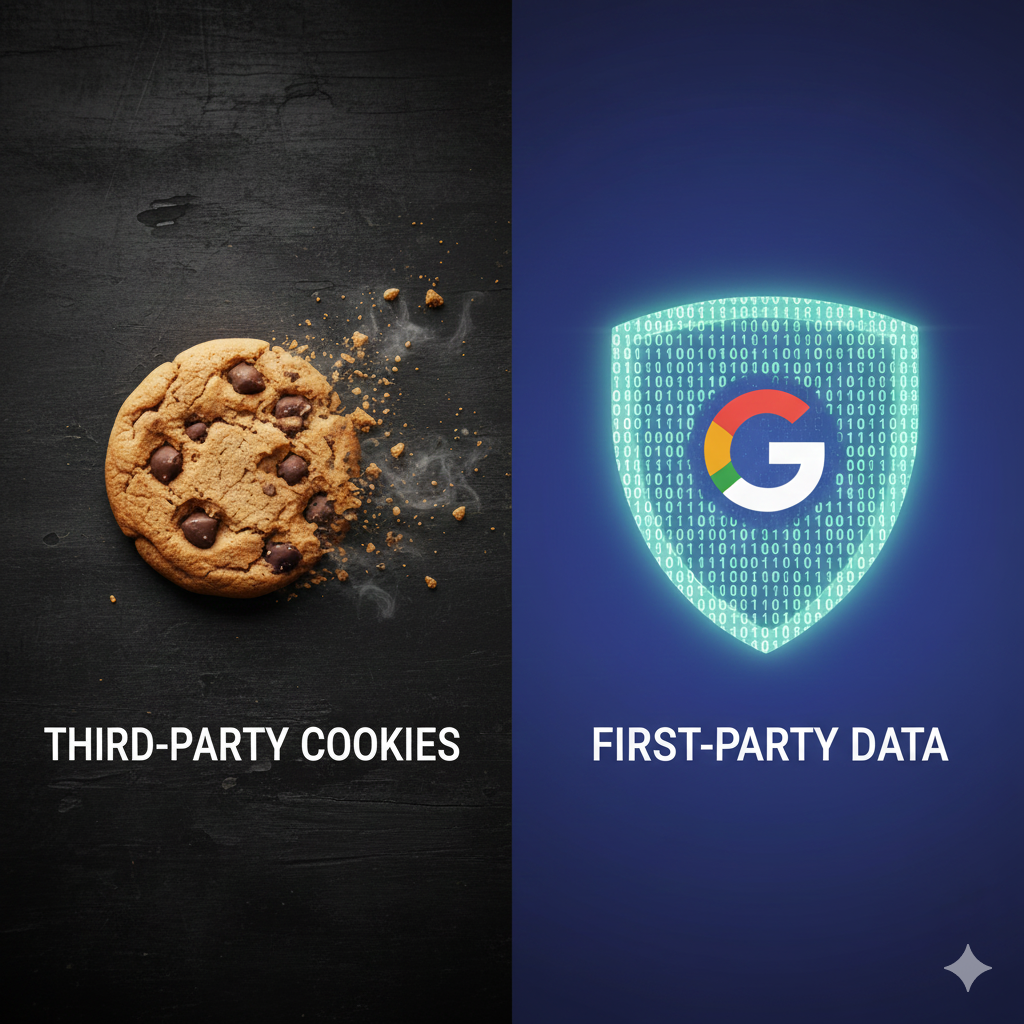
For years, digital marketers have been preparing for the “Cookie Apocalypse.” We were told that by 2024, third-party cookies would be extinct, and we’d all be flying blind.
Then, in a plot twist worthy of a Netflix drama, Google reversed course in mid-2024. Instead of killing third-party cookies in Chrome entirely, they shifted to a “User Choice” model.
So, are we safe? Absolutely not.
While the cookie didn’t technically “die,” it is on life support. Safari and Firefox already block them by default. Millions of Chrome users are opting out. The result is the same: Signal Loss.
In 2026, if you are relying on the Google Pixel alone to tell you who converted, you are feeding the algorithm incomplete data. And when you feed an AI incomplete data, it makes expensive mistakes.
The new winners in advertising aren’t the ones with the best ad copy; they are the ones with the best First-Party Data Strategy. Here is how to build yours to lower your CPAs and train Google’s AI to find your most profitable customers.
The Problem: “Blind” Bidding
Imagine sending a salesperson out to find new clients, but you never tell them which leads actually bought your product. They would just keep bringing you anyone who answers the phone, wasting your budget on low-quality prospects.
This is exactly what happens with Smart Bidding (Target CPA, Target ROAS) when you rely solely on standard web pixels.
- The Gap: A user clicks your ad, fills out a form, and becomes a “Lead.” The pixel fires. Google Ads thinks, “Great job!”
- The Reality: That lead was spam, or they couldn’t afford your services. But Google doesn’t know that. It goes out and finds more people just like them.
To fix this, we need to bridge the gap between what happens on your website and what happens in your bank account.
The Solution: The “Data Power Trio”
In 2026, a robust First-Party Data strategy revolves around three core pillars. Implementing these is no longer “advanced” it’s mandatory for survival.
1. Enhanced Conversions (The Low-Hanging Fruit)
If you do nothing else after reading this article, enable Enhanced Conversions.
What it is: When a user converts on your site (e.g., buys a shoe or fills out a form), they typically type in their email address or phone number. Enhanced Conversions hashes this data (using a secure SHA256 algorithm) and sends it back to Google.
Why it lowers CPAs: Google matches that hashed email against its massive database of logged-in users. This allows Google to recover conversions that were lost due to cookie blocking (e.g., a user who clicked an ad on their iPhone but bought on their desktop).
- The Impact: Data shows that advertisers who switch this on see an average 5–10% increase in measured conversion rates which instantly lowers your CPA.
2. Google Ads Data Manager (The New Hub)
Gone are the days of wrestling with complex API integrations or manually uploading CSV files every Friday.
Google Ads Data Manager (formerly the “Linked Accounts” section but on steroids) is now the central nervous system for your first-party data. It offers a point-and-click interface to connect your data sources directly to Google Ads.
What to connect:
- Your CRM: (HubSpot, Salesforce, Zoho).
- Your Data Warehouse: (BigQuery, Snowflake).
- Your Email Marketing Tool: (Mailchimp, Klaviyo).
By connecting these, you automate the flow of customer lists and offline results directly into the ad platform.
3. Offline Conversion Imports (The Secret Weapon)
This is critical for Lead Generation and B2B businesses.
Stop optimising for “Leads.” Start optimising for “Qualified Leads” or “Deals.”
How it works:
- A user clicks an ad. Google assigns a “GCLID” (Google Click ID) to that visitor.
- The visitor fills out a form. You save that GCLID in your CRM alongside their name.
- Two weeks later, your sales team marks that lead as “Closed Won.”
- Your CRM (via Data Manager) tells Google: “Hey, remember GCLID https://www.google.com/search?q=%2312345? They just spent £5,000.”
The Result: Google’s AI stops bidding for cheap form-fillers and starts bidding for high-value deal-closers. We’ve seen Bizi Digital clients reduce their cost-per-qualified-lead by 30% just by making this switch.
Action Plan: Building Your “Moat”
First-party data is a competitive moat. Your competitors can copy your ad text, but they cannot copy your customer data. Here is your checklist to get started:
Not sure where to start?
We help businesses build marketing systems that actually work. Let us show you how.
Get Your Free Growth Plan →Step 1: Audit Your Tagging
Ensure you are using the Google Tag (gtag.js) site-wide or a robust Google Tag Manager container. Without this foundation, Enhanced Conversions won’t work effectively.
- Check: Are you using “Consent Mode v2”? If you have traffic from the EU/EEA, this is legally required to collect data for personalisation.
Step 2: Segment Your Customer Match Lists
Don’t just upload one giant list called “All Emails.” Segment them:
- Whales: Top 10% of spenders (Bid higher for lookalikes).
- Churned: Customers who haven’t bought in 6 months (Target with “We Miss You” offers).
- Leads: People who signed up but never bought (Exclude them from “Brand Awareness” campaigns to save money).
Step 3: Shift to Value-Based Bidding
Once you are feeding offline data back into Google, switch your bidding strategy from Target CPA to Target ROAS (even for lead gen!).
Assign values to your lead stages:
- Form Fill = £0 (Don’t optimise for this)
- Qualified Lead = £50
- Closed Deal = £1,000
This forces the Smart Bidding algorithm to chase the value, not the volume.
Conclusion: Own Your Data, Own the Auction
The “Cookie Apocalypse” was never about the death of tracking; it was about the death of lazy tracking.
In 2026, the advertisers winning the auction aren’t the ones with the biggest budgets. They are the ones who have built a direct bridge between their business data and Google’s brain. By implementing Enhanced Conversions and Offline Imports, you aren’t just measuring success you are engineering it.Is your data stuck in a silo?Contact Bizi Digitalfor a First-Party Data Audit, and let’s get your CRM talking to Google Ads.
FAQ: First-Party Data Strategy
Yes. The feature uses a “hashing” process (SHA256) which turns personal data (like emails) into a string of random characters before it leaves your website. Google never sees the actual email address, only the hashed string, which it matches against its own hashed database.
If you sell products directly on your website (e-commerce), probably not standard tracking works fine. But if you rely on phone calls, quotes, or sales teams to close deals, then yes. Without it, you are optimizing for “quantity of leads” rather than “quality of sales.”
No, the tool itself is free within Google Ads. However, some third-party connectors (like Zapier or specific CRM integrations) might have their own subscription fees depending on the volume of data you sync.