For the last ten years, the Google Ads plan was simple. You focused on getting the click. You waited for someone to type a keyword like “best accounting software” or “emergency plumber.” Then you paid to show up. This worked, but it was reactive. You were limited by the number of people searching.
In 2026, we have hit a “Search Ceiling.” Costs are at all-time highs. Search volume for many industries has stopped growing. If you only use Search ads, you are fighting for a fixed number of customers.
Enter the “Power Pair.”
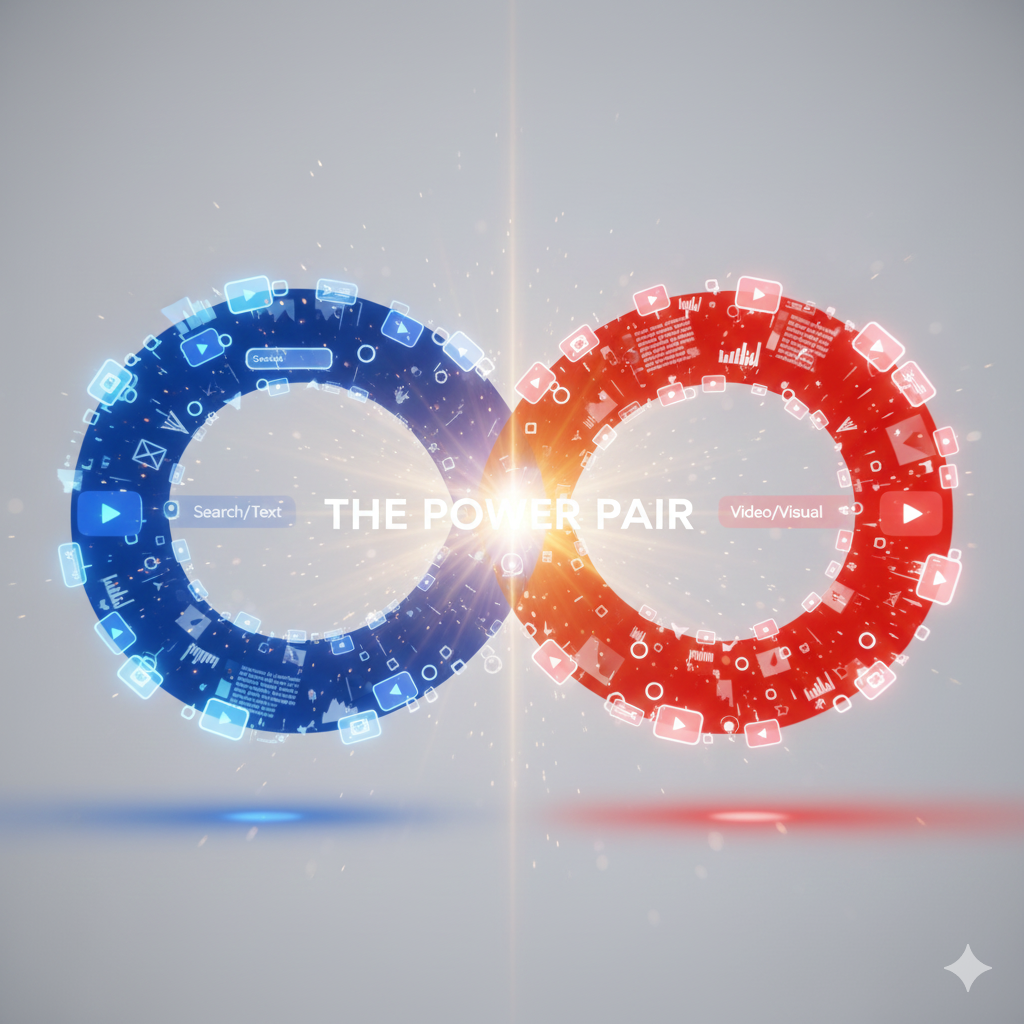
This is the strategic mix of AI-Powered Search and Demand Gen campaigns. It is not just a bundle. It is a major shift. You move from capturing demand to creating it. You combine the precision of Search with the huge reach of YouTube Shorts and Discover. This creates a system that helps you grow in ways that keywords alone cannot.
Here is why the Power Pair is the new standard for growth and how to use it.
What is the “Power Pair”?
To see why this works, we must look at the role each part plays in the AI era.
1. The Anchor: AI-Powered Search
This is your “closer.”
- The Upgrade: In 2026, Search is more than exact keywords. It uses “Broad Match” and “Smart Bidding.” It uses billions of data points to predict who is ready to buy right now.
- The Limit: It relies on the user taking the first step. If they do not search, you do not exist to them.
2. The Accelerator: Demand Gen
This is the new version of Discovery Ads. It is Google’s answer to social ads like Meta or TikTok. However, it is built on Google’s powerful data.
- The Placements: It appears on visual platforms. This includes YouTube Shorts, YouTube In-Stream, the Discover Feed, and Gmail.
- The Goal: It does not wait for a search. It puts your brand in front of potential customers before they even know they need you.
- The Synergy: Demand Gen plants the seed (Awareness). Search harvests the fruit (Conversion).
Why They Work Better Together
You might think you already run ads on Meta for awareness. Why do you need Demand Gen?
The answer is Data Continuity.
When you run ads on Facebook and Search on Google, the platforms do not talk to each other. Facebook claims the view. Google claims the search. You end up with messy data. With the Power Pair, both campaigns share the same brain: Google AI.
1. Shared Audience Signals When a user watches your YouTube Short but does not click, Google knows. If that same user searches for a related keyword three days later, your Search campaign knows. It can bid higher for them because they are already interested.
2. Better Lookalike Audiences Demand Gen lets you build “Lookalike Segments” based on your own data, such as your email list.
- The Strategy: You upload a list of your top 10% customers.
- The Action: Demand Gen finds 500,000 people with similar habits on YouTube.
- The Result: It shows them visual ads. Later, Search captures them when they Google your brand name.
3. The “Cost Blending” Advantage Search is expensive. For example, it might cost £15 per click. Demand Gen is cheap. It might cost £0.50 per click.
By mixing the two, you lower your overall cost. You bring cheap traffic into the top of your funnel. This makes your expensive clicks at the bottom convert at a much higher rate.
Industry Stat: Advertisers who add Demand Gen to their Search campaigns see an average 14% increase in conversions at a similar cost.
Executing the Strategy: A Step-by-Step Guide
Ready to use the Power Pair? Do not just launch two random campaigns. Structure them to help each other.
Not sure where to start?
We help businesses build marketing systems that actually work. Let us show you how.
Get Your Free Growth Plan →Step 1: Fix Your Assets (Video is Key) You cannot run Demand Gen without visuals.
- The “Shorts” Requirement: You need vertical (9:16) videos under 60 seconds. This is where the volume is.
- The Creative Hook: Search solves a problem. Demand Gen must stop the scroll. Focus on emotion, style, or a surprise in the first 3 seconds.
Step 2: Set Up “Audience Leaking”
- In Demand Gen: Target “In-Market” segments and “Lookalikes” of your buyers.
- In Search: Apply those same audiences as “Observation” layers. This lets you see if the people watching your videos are the ones searching later.
Step 3: Budget Allocation (The 70/30 Rule) For most businesses starting this strategy:
- 70% Budget -> Search: Keep the lights on and capture ready-to-buy traffic.
- 30% Budget -> Demand Gen: Build your future pipeline.
Warning: Do not judge Demand Gen by “Last Click” results. If you do, you will turn it off in a week. You must look at “View-Through Conversions” and “Assisted Conversions.”
Power Pair vs. Performance Max: What is the Difference?
A common question at Bizi Digital is this: “Doesn’t Performance Max (PMax) already do all of this?”
Yes and no.
Performance Max is a “black box.” It mixes Search, Shopping, Display, YouTube, and Maps into one giant campaign. You hand over the keys, and Google drives.
The Power Pair is for people who want control.
- Separation: It keeps your Search budget separate from your Video budget.
- Creative Control: In Demand Gen, you choose exactly which videos run. In PMax, Google might make a video you hate.
- Strategic Bidding: You can bid high on Search to protect your brand. You can bid low on Demand Gen just to get views. PMax forces one target across everything.
Verdict: Use PMax for e-commerce where you have many products. Use The Power Pair for Lead Gen, B2B, or high-value services.
Conclusion: Stop Waiting, Start Generating
The era of “keywords-only” marketing is over. In 2026, the user journey is a messy web of TikToks, YouTube Shorts, Google searches, and AI summaries.
If you are only present at the final search, you are paying the highest price for the customer. The Power Pair allows you to show up earlier, build trust cheaper, and own the customer relationship before they even type a query.
Don’t just wait for the demand. Generate it.
Not sure if your creative assets are ready for Demand Gen? Contact Bizi Digital for a Creative Audit and Power Pair setup.
FAQ: Google Ads Power Pair
You can run it with just images (Carousel ads), but you will miss out on the massive inventory of YouTube Shorts, which is the biggest driver of cheap traffic right now. We highly recommend investing in at least 2–3 short-form videos.
Unlike Search (which is immediate), Demand Gen is a mid-funnel strategy. It typically takes 4–6 weeks to “seed” the audience and see the uplift in your Search volume.
It can if you aren’t careful. If you run PMax and Demand Gen simultaneously, PMax usually takes priority. We recommend using Demand Gen for specific audiences (e.g., Lookalikes) that you want to target aggressively, while leaving PMax to handle broader conversion goals.