Harnessing AI to Boost Your Google Ads Quality Score

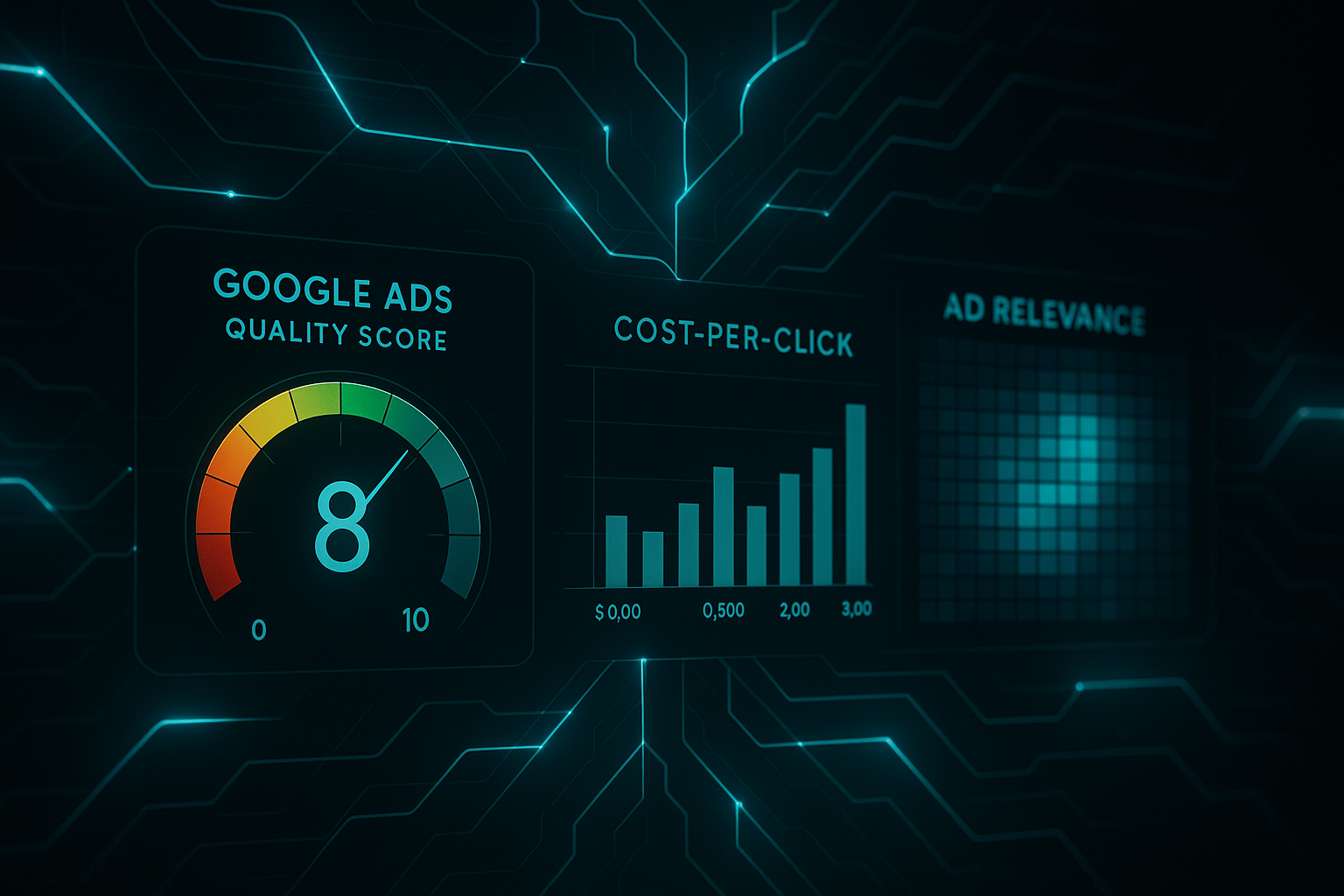
Futuristic AI dashboard showing Google Ads Quality Score and metrics

In today’s competitive digital world, a high Google Ads Quality Score is key to success. It helps you get better ad spots while keeping your costs low.

A good score leads to cheaper clicks (lower CPC) and a better return on your investment. Now, Artificial Intelligence (AI) offers marketers amazing new ways to improve every part of their campaigns. Finding the right balance between AI vs human decision-making in Google Ads is crucial. You want to use automation to help you, not replace you.

This guide explores how to use AI to improve your score and get better business results.

What Is Google Ads Quality Score?

Think of Quality Score as a grade from 1 to 10 that Google gives your ads. It measures how helpful and relevant your ads are to users. A higher score means better results.

There are three main parts to this score:

  • Ad Relevance: Does your ad text match what the user searched for?

  • Landing Page Experience: Is your website fast, mobile-friendly, and helpful?

  • Expected Click-Through Rate (CTR): How likely are people to click your ad based on past performance?

Using AI to improve these areas can boost your score significantly. However, you also need to check your account regularly. It is vital to avoid wasting money by performing systematic campaign optimization checks.

1. Improve Ad Relevance with AI

You need your ads to match exactly what people are looking for. AI makes this easier.

  • Responsive Search Ads (RSAs): Google’s AI mixes your headlines and descriptions to find the best combination. If you give it 15 headlines and 4 descriptions, the AI learns which version works best for different users.

  • AI Copywriting: Tools like ChatGPT or Google’s Duet AI can look at your past data and competitor ads to suggest better text. You can also see how generative AI enhances visual storytelling to create more exciting ads. For example, you can ask AI to: “Write 5 urgent headlines for ‘sustainable packaging’.”

  • Finding Hidden Keywords: AI tools (like Semrush or Ahrefs) can find “long-tail keywords”—specific phrases that have less competition. These often cost less and bring in better customers.

2. Create Better Landing Pages

Getting a click is only half the battle. Your website needs to keep the user interested.

  • Personalization: Tools like Dynamic Yield can change the text or images on your website based on who is visiting. If the content matches the user, they stay longer, which improves your score.

  • Automated Testing: Google and Adobe offer tools that test different versions of your webpage automatically. They learn which layout gets the most sales and send more traffic there.

  • Speed Checks: Slow sites hurt your score. Use AI tools to find and fix speed issues. Understanding why letting AI bots crawl your site matters is essential for good SEO and a high Quality Score. A faster, mobile-friendly site helps everyone.

3. Smarter Bidding with Predictive Analytics

AI is great at predicting the future using past data.

  • Smart Bidding: Google’s strategies now include “Maximize conversion value.” AI guesses which searches will make money and adjusts your bid in real-time. This is part of a larger shift in AI for marketing transformation.

  • Predicting Trends: By connecting your data to AI models, you can predict busy times like holidays. For online stores, mastering the holiday sales calendar allows you to adjust your budget before the rush, keeping your Quality Score high when it matters most.

4. Automation & Constant Updates

AI works 24/7 to keep your ads performing well.

  • Scripts: You can use simple code (scripts) to automatically pause bad keywords or change bids when performance drops.

  • Performance Max: This tool uses Google’s full AI power to show ads across Search, YouTube, Gmail, and more. It optimizes everything to get you the most conversions. It is a prime example of how AI is revolutionising Google Ads through efficiency and precision.

  • Auto-Recommendations: Check the “Insights” page in Google Ads. The AI will suggest simple fixes, like adding a keyword or changing an image, to quickly boost your score.

5. Ethics & Privacy

As AI uses more data, keeping user trust is essential.

  • Respect Privacy: Laws are changing. Ensure your AI tools respect user consent and use anonymous data. Knowing the Google Advertiser verification requirements helps you build trust and keep your ads running smoothly.

  • Transparency: Use dashboards that show you why an AI made a decision. This helps you stay accountable. The importance of conversion tracking is even greater now, as you need good data to guide the AI.

Conclusion

AI is no longer optional—it is the backbone of successful Google Ads campaigns. By using AI to write copy, personalize pages, and bid smarter, you can raise your Quality Score and lower your costs.

For businesses wanting to grow, learning how to scale your clothing brand with Google Ads using these AI strategies is the next step. Stay updated on the latest features to keep your campaigns ahead of the curve.

AI for Marketing: Transforming Digital Strategy in 2025

In 2025 the integration of AI for marketing has moved well beyond trend status and matured into an operational reality for brands of every size. The surge in artificial intelligence adoption is not about replacing marketers but equipping them with tools that streamline, personalise and scale campaigns with precision previously impossible. Understanding AI vs human decision-making in Google Ads is crucial for maximizing this potential. If you have felt fatigued by the same old pitches this is not more noise; it is an opportunity to make your brand’s signal shine.

Understanding AI in Marketing: More Than Just Automation

Many still view AI through the narrow lens of automation, such as emails sent, ads optimised or social posts scheduled with a click. That is just the tip of the iceberg. Today, AI in marketing means deep-learning algorithms mining customer data, predictive analytics refining campaigns in real time and dynamic creative that adapts to individual preferences instantly. Discover how AI is revolutionising Google Ads with efficiency and precision that was unimaginable just years ago.

AI excels at sifting through vast data sets to unearth patterns and correlations that marketing teams would never spot in spreadsheets alone. The real shift is from simple automation to autonomous decision making. Tools can recommend campaign adjustments, flag emerging opportunities and identify at-risk segments before the data analyst has even arrived at their desk. Learn how to harness AI to boost your Google Ads Quality Score through these automated optimizations.

For operators who crave clarity and efficiency this means more time spent on strategy and less time lost to manual drudgery. Major brands such as Coca-Cola and Nike are building their 2025 playbooks around these capabilities but the tools are just as accessible to smaller teams looking for an edge.

Personalisation at Scale: How AI Knows Your Audience

The hallmark promise of AI-powered marketing is personalisation at scale. Think of Netflix, Spotify or Amazon: every interaction feels tailor-made and that is no accident. AI leverages customer data from browsing habits to transaction histories—to deliver content, offers and experiences unique to each user. That goes far beyond a name-tag salutation in an email.

Today, AI can adjust entire landing pages, product suggestions and ad sequences on the fly ensuring relevancy and boosting conversion rates. Explore how generative AI enhances visual storytelling in your ad campaigns to create truly personalized experiences.

This granular approach relies on robust data pipelines and intelligent segmentation. AI does not just parse demographics; it understands intent, behaviour and real-time feedback. Early adopters in e-commerce have seen bounce rates tumble and basket sizes swell by using algorithms that anticipate customer needs. The fewer the points of friction and the more ‘wow’ moments along the customer journey the greater the loyalty you win. For benchmarking see McKinsey’s personalisation resources here.

Predictive Analytics: From Gut Feeling to Data-Driven Decisions

The days when marketers relied solely on instinct and historic trends are over. AI for marketing now powers predictive analytics platforms that forecast everything from campaign performance to inventory needs. By ingesting vast swathes of data—site behaviour, ad engagement and CRM inputs—machine-learning models can predict what customers will do next. Understanding why letting AI bots crawl your site matters is essential for this comprehensive data collection process.

These insights empower marketers to adapt strategies proactively, allocate budgets more wisely and reduce waste. Consider dynamic pricing which sets prices based on demand, competitor activity and even weather forecasts. Or lead-scoring models that tell sales teams who to call, when to call and with which offer. Once the preserve of large CRM stacks solutions such as HubSpot, Salesforce and Shopify now offer plug-and-play predictive modules bringing these capabilities within reach of smaller teams. For practical overviews explore Salesforce Einstein here.

AI Content Creation: Speed Meets Relevance

AI-generated copy, video and design are now routine fixtures in the modern marketer’s toolkit. Whether drafting SEO-optimised blog posts, creating ads for hundreds of audience segments or generating real-time chatbot responses AI content tools deliver speed with surprising nuance. However, it’s crucial to avoid wasting ad spend through proper targeting and optimization, regardless of how sophisticated your content creation becomes.

Struggling with repetitive tasks or writer’s block? These platforms are a creative ally not a threat. The result is an ecosystem where human insight and AI horsepower work in harmony. Human editors set tone and guardrails while AI fills in the gaps at scale. Even microcopy such as calls to action and subject lines benefit from AI’s relentless split testing.

Concerned about plagiarism, blandness or loss of brand voice? The solution lies in careful curation and clear prompting. See what’s possible at Copy.ai or Jasper.

Ethics, Bias and the Human Element: Getting It Right

With great power comes great responsibility. As AI for marketing becomes more deeply embedded in campaigns risks such as bias, targeting abuses and privacy violations increase. Algorithms can only be as objective as the data used to train them and that data often reflects societal prejudices. Marketers must audit their models rigorously, demand explainable AI and champion consumer privacy at every turn. This includes understanding Google Advertiser verification requirements for maintaining trust and credibility.

Crucially the best results arise when humans and AI combine strengths. While algorithms crunch data and optimise in seconds humans provide context, empathy and creativity. Leading marketers invest in AI upskilling and ensure ‘human-in-the-loop’ collaboration. For evolving standards consult Google AI’s Responsible Practices here.

Conclusion: AI for Marketing Is Quietly Reshaping the Industry

In a world that values clarity over clatter AI for marketing offers a significant competitive advantage. It is not a silver bullet but a compounding asset that aligns your resources and strategies ever closer to your audience. Whether you are a founder craving control an operations lead needing granular data or a creative professional wary of robotic hype real leverage comes from balance: harness AI’s power while preserving your brand’s humanity.

The journey does not end here. As AI matures expect faster tools, smarter targeting and greater ethical scrutiny. For now embrace the transformation. The age of the quiet operator has arrived and with the right approach your marketing can finally move at the speed your customers demand. Ready to implement these strategies? Learn how to scale your clothing brand with Google Ads using these AI-powered approaches.