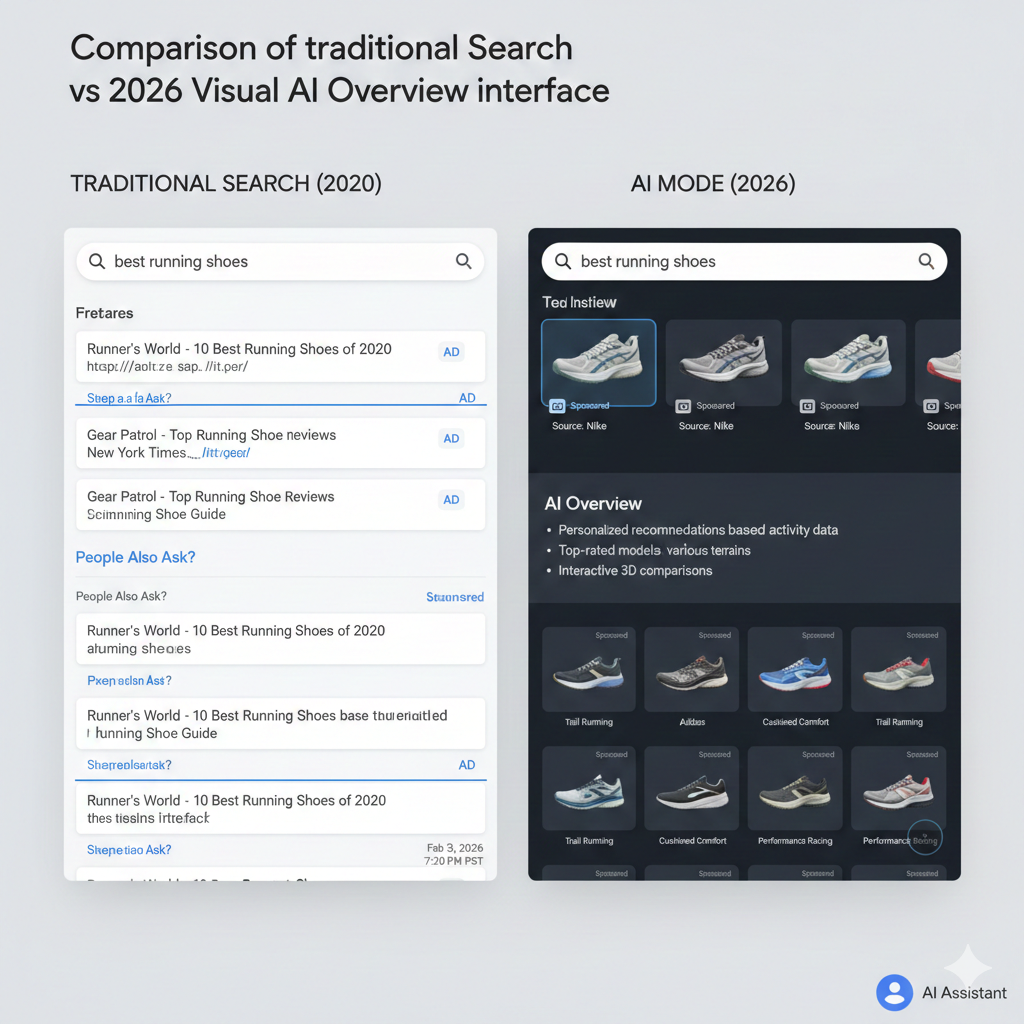
Visual AIO: Mastering Images in Google AI Overviews 2026
The Multimodal Shift: Why Your Pixels Matter More Than Your Prose
In the past, Google’s bots “read” your website. In 2026, thanks to the Gemini 2.5 multimodal engine, they “see” it.
Google’s new Visual Fan-out technique allows the AI to deconstruct your images, identifying secondary objects, textures, and even the “vibe” of a scene. For example, if you sell a mid-century modern chair, Google doesn’t just see a chair; it sees the lifestyle context, the lighting, and the complementary decor. It uses that data to answer complex conversational queries like: “Find me a reading nook setup that feels cosy but minimalist.”
Here is how to ensure your brand’s visuals are at the heart of these AI-generated answers.
1. The Rise of Visual GEO (Generative Engine Optimisation)
Traditional Image SEO was about alt-text and file size. In 2026, we practise Visual GEO. This is the process of making your images “machine-intelligible” so they are chosen as the primary visual citations in an AI Overview.
- Contextual Anchoring: Google now prioritises images that are physically close to the “answer passage” on your page. If your text explains a process, the diagram must be nested within that specific
<div>or<section>to be linked as a citation. - The “Vibe” Metadata: Beyond alt-text, Google uses the Shopping Graph to understand the aesthetic of an image. Ensure your images are high-resolution (at least 1200px) and avoid generic stock photography, which AI models now filter out as “low-value clutter.”
2. Optimising for “AI Mode” and Conversational Shopping
Google’s AI Mode has turned search into a dialogue. Users can snap a photo of a coat they like and ask: “Find this in navy blue and under £150.” To appear in these results:
- Multi-Angle Assets: Provide at least 5 to 7 high-quality images per product. The AI needs to “understand” the 3D volume of your product to recommend it with confidence.
- Clean Backgrounds vs. Lifestyle: You need both. Clean, white-background shots help the AI identify the entity (the product), while lifestyle shots provide the contextual metadata for “vibe-based” queries.
3. The Technical Standard: Schema 3.0 and UCP
In 2026, the Universal Commerce Protocol (UCP) is the industry standard. This is an open-source metadata framework co-developed by Google, Shopify, and Walmart to help AI agents “read” product availability, materials, and carbon footprint directly from the data feed.
- Image Schema: Use
ImageObjectandProductschema in tandem. Specifically, ensure thesignificantItemproperty is defined so the AI knows exactly what the focal point of the image is. - WebP & AVIF are Non-Negotiable: Speed is still a ranking factor for the retrieval stage of AIO. If your images take more than 100ms to load, the AI will likely skip them for a faster alternative.
4. Visual E-E-A-T: Authenticity in the Age of Synthetic Media
With the web flooded by AI-generated “slop,” Google has doubled down on Visual E-E-A-T. They are looking for “Proof of Human Experience.”
- C2PA Metadata Watermarking: Use C2PA standards (Content Credentials) to verify that your images are original. Google’s Pixel 10 and other 2026 flagship devices now embed this by default to prove an image was captured by a real camera.
- User-Generated Content (UGC): Images from real customers (reviews) are often weighted more heavily in AIO citations than professional brand shots because they provide “social proof” that the AI can verify through sentiment analysis.
Summary: Your 2026 Visual Checklist
To dominate the AIO in 2026, your strategy must move beyond text:
- Audit for “Visual Gaps”: Does every H2/H3 on your site have a supporting image or diagram?
- Implement UCP Metadata: Ensure your product feed is optimised for the Universal Commerce Protocol.
- Humanise Your Assets: Replace generic stock photos with original, high-authority photography that includes C2PA provenance.
FAQ:
Yes. Google frequently pulls images from the top 10 results to illustrate an AI Overview, even if the primary text source comes from the #1 spot. This is why “Visual GEO” is such a high-leverage opportunity.
Absolutely. Visual searches (Lens) often trigger Shopping Ads within the AI interface. If your images are not optimised, your competitor’s “visual match” will win the placement, even if your bid is higher.
se them sparingly for concepts, but never for products or “Expert” content. Google’s 2026 algorithm is designed to prioritise “Original Human Experience” (the first ‘E’ in E-E-A-T).