If you lead a £500k+ B2B business, you have likely spent years perfecting your traditional search strategy. You know the exact short-tail keywords your customers type into Google, and your ads are perfectly calibrated to capture those clicks. But customer behaviour is shifting rapidly, and the keyboard is no longer the only way your prospects are searching.
Today, business owners, executives, and procurement managers are increasingly relying on voice assistants—from Siri and Google Assistant on their daily commute to advanced AI chatbots acting as virtual researchers. By 2026, voice and conversational AI search represent a massive, largely untapped channel for B2B lead generation.
However, optimising for a spoken question is vastly different from optimising for a typed keyword. If your marketing strategy still relies entirely on traditional search mechanics, you are becoming invisible to a growing segment of high-intent buyers.
In this guide, we will break down what Voice Search AEO (Answer Engine Optimisation) is, how conversational queries impact your paid advertising, and exactly how to prepare your content and Google Ads for a voice-first world.
The Death of the “Caveman” Keyword
To understand Voice Search AEO, you must first understand how human behaviour changes when we speak rather than type.
When a B2B buyer uses a keyboard, they type like a caveman. They strip away grammar to save time, typing fragmented queries like: “B2B CRM software London” or “Google Ads agency pricing.” When that same buyer uses a voice assistant, they speak in complete, natural sentences. The query transforms into: “What is the best CRM software for a London marketing agency with 20 employees?” or “How much does a Google Ads agency typically charge a B2B business per month?”
These voice queries are fundamentally different. They are conversational, they are long-tail (often five to ten words long), and most importantly, they are heavily loaded with buying intent. A user asking a hyper-specific, multi-part question aloud is typically much further down the sales funnel than someone typing a generic two-word phrase.
What is Voice Search AEO?
Answer Engine Optimisation (AEO) is the practice of structuring your digital content so that generative AI models and search engines can easily extract it to provide a single, direct answer to a user’s question.
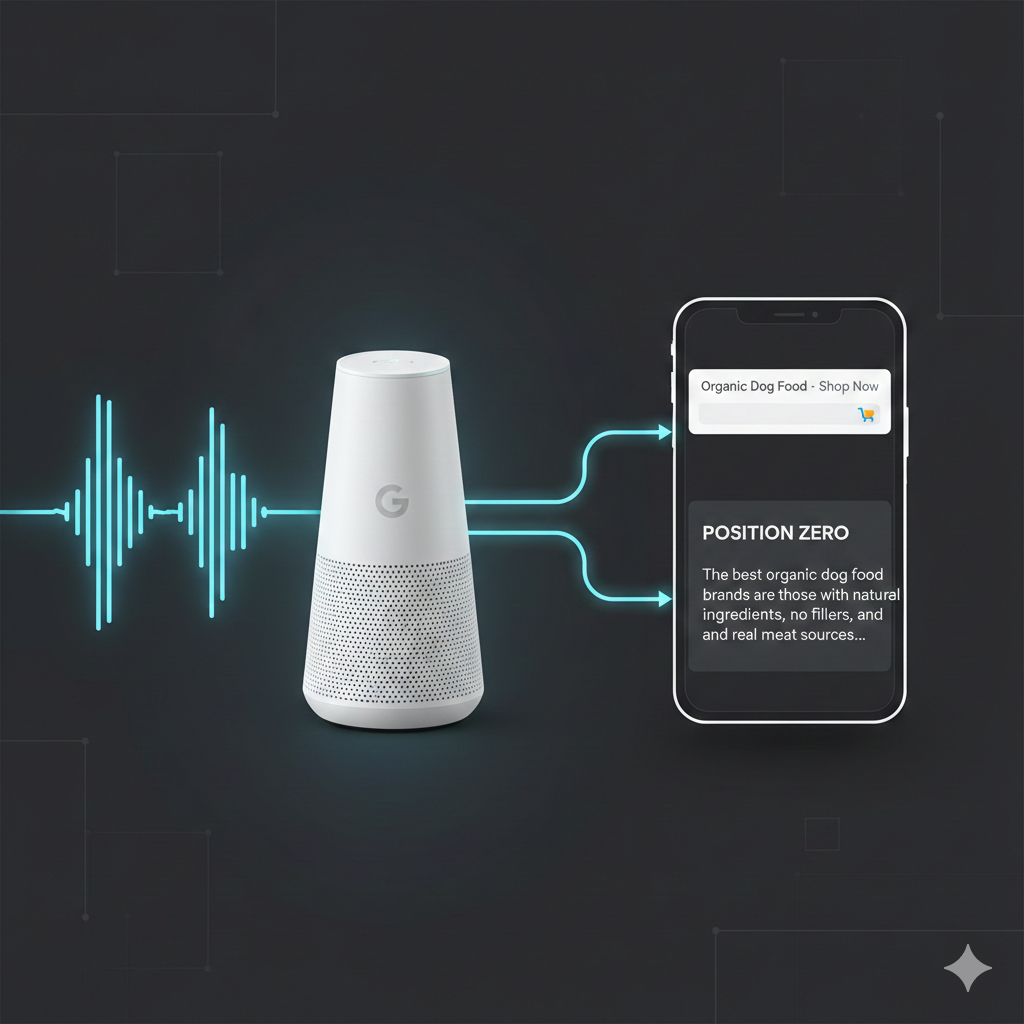
While traditional SEO focuses on getting your website listed on page one of the search results (so the user can click and read it themselves), Voice Search AEO has a different goal: Position Zero.
When a user asks a voice assistant a question, the AI does not read out a list of ten blue links. It reads a single, definitive answer aloud. It typically pulls this answer directly from a “Featured Snippet” or an AI Overview at the very top of Google’s search results.
If your website is not structured to be the singular, authoritative answer, your business simply does not exist in a voice search scenario. It is a winner-takes-all environment.
(Internal Link: Want to understand the broader implications of AI on your organic visibility? Read our comprehensive guide, Pillar 2: Answer Engine Optimisation (AEO): Future-Proofing Your Search Visibility.)
4 Strategies to Optimise Your Content and Ads for Voice Search
Winning in voice search requires a blended approach. You must optimise your organic content to capture the spoken AI answers, while simultaneously adapting your paid Google Ads to intercept these new, conversational search patterns. Here is the four-step framework we use for our scaling B2B clients.
Not sure where to start?
We help businesses build marketing systems that actually work. Let us show you how.
Get Your Free Growth Plan →1. Shift to Conversational, Question-Based Keywords
You cannot optimise for voice search using standard keyword volume tools, because conversational queries are too long and unique to register massive monthly search volumes. Instead, you must optimise for intent and natural language.
- Target the 5 Ws: Structure your content around Who, What, Where, When, Why, and How. Voice searches overwhelmingly begin with these trigger words.
- Mine Your Sales Calls: The best voice search keywords are not found in SEO software; they are found in your CRM. Listen to recorded discovery calls. The exact questions your prospects ask your sales reps aloud are the exact questions they are asking Google Assistant.
- Create FAQ Hubs: Build dedicated FAQ pages on your website that directly ask these conversational questions in the headings (e.g., “How long does it take to implement marketing automation?”).
2. Capture “Position Zero” with Direct Answers
AI voice assistants are ruthlessly efficient. They do not want to read a 500-word introductory paragraph filled with marketing jargon. They want the answer immediately.
To capture the featured snippet that voice assistants read aloud, you must adopt an “Answer-First” writing style:
- Ask the Question: Make the H2 heading the exact conversational question.
- Give the Direct Answer: Immediately below the heading, provide a concise, factual answer in 40 to 60 words. No fluff.
- Elaborate Below: After you have provided the direct answer, you can use the rest of the page to dive into the nuanced details, case studies, and sales pitches for human readers who click through.
3. Implement FAQPage Schema Markup
If your content is the meat, schema markup is the skeleton. Schema is a form of microdata (added to your website’s code) that acts as a direct translator for AI bots and search engines.
When you implement FAQPage Schema or HowTo Schema, you are explicitly telling Google: “This string of text is a direct question, and the paragraph below it is the definitive answer.” This removes all the guesswork for the Answer Engine. Websites that deploy robust schema markup are exponentially more likely to be selected as the spoken answer by Siri, Alexa, or Google Assistant.
4. Upgrade Your Google Ads for Voice Intent
Voice search does not just impact organic results; it drastically alters how your paid ads perform. If someone uses voice search on a mobile device or a smart display, Google still shows text and local service ads at the top of the screen before the organic answer.
Here is how to align your Google Ads with voice behaviour:
- Embrace Broad Match + Smart Bidding: Because voice queries are incredibly diverse and long-tail, it is impossible to build Exact Match keyword lists for every variation. You must lean into Broad Match keywords paired with AI-driven Smart Bidding (like Target CPA or Target ROAS). This allows Google’s algorithm to map the user’s conversational intent back to your core offering, even if they use phrasing you never anticipated.
- Review Your Search Terms Report for Voice Signals: Regularly audit your Search Terms report. Look for queries starting with “Hey Google…” or containing filler words like “near me,” “for my business,” or “how do I.” These are voice searches.
- Write Conversational Ad Copy: If a user asks a conversational question, your ad copy should feel like a conversational response. Instead of a robotic headline like “Buy B2B Software UK,” test headlines that directly address the voice intent, such as “The B2B Software Built for UK Agencies.”
(Internal Link: Discover how to master Smart Bidding and AI campaign structures in Pillar 1: AI in Google Ads: The Ultimate Guide to Scaling Profitably.)
The Bizi Digital Approach: Omnichannel AI Dominance
As search engines evolve into Answer Engines, siloed marketing strategies are failing. You can no longer have one agency handling your SEO, another handling your Google Ads, and an internal team guessing at automation.
At Bizi Digital, we build connected systems specifically for businesses scaling past the £500k mark.
We know that a strong Voice Search AEO strategy feeds directly into your paid advertising efficiency. By structuring your site to answer conversational queries, you improve your organic E-E-A-T (Experience, Expertise, Authoritativeness, and Trustworthiness). This high-quality, relevant content naturally improves your Google Ads Quality Scores, lowering your Cost-Per-Click and ensuring that when a CEO asks their phone for the best solution in your industry, your brand dominates both the spoken answer and the paid ad slots.
(Internal Link: Ready to capture these high-intent leads and route them instantly to your sales team? Explore our AI & Marketing Automation services.)
Conclusion: Speak Your Customer’s Language
Voice search is no longer a futuristic novelty reserved for asking about the weather or setting kitchen timers. It is a primary research tool for busy decision-makers.
The businesses that win the next decade of digital marketing will be those that stop trying to game outdated keyword algorithms and start genuinely answering their customers’ questions. By implementing structural AEO, targeting conversational intent, and allowing Google’s AI to match your ads to long-tail voice queries, you future-proof your pipeline against the biggest shift in search behaviour since the smartphone.
Frequently Asked Questions
Yes. While voice search originated with consumer queries (e.g., ordering pizza or playing music), it has rapidly infiltrated the B2B space. Executives and procurement managers frequently use mobile voice search between meetings or during commutes to ask high-level research questions, compare software pricing, or find local B2B service providers.
Currently, Google Analytics does not separate voice searches into a distinct category—they are blended into your standard organic or paid search traffic. To track voice impact, you must look for qualitative indicators in your Search Console and Ads Search Terms reports. Filter for queries that are 6+ words long, phrased as complete questions, or include typical voice trigger words like “Hey Google.”
Not at all. Optimising for voice search actually enhances your traditional SEO. Search engines heavily reward websites that provide clear, well-structured, and highly relevant answers to user queries. The exact formatting changes required for Voice AEO (like short paragraphs, clear headings, and schema markup) will also boost your standard text-based organic rankings.
It can, if your negative keyword lists and bidding strategies are outdated. Because voice searches are often broad and conversational, using legacy manual bidding with loose match types can trigger your ads for irrelevant queries. However, by utilising Value-Based Bidding and closed-loop CRM integration, you train the algorithm to only bid on voice queries that exhibit the specific behaviour of your high-value buyers.